
Look through a dozen photographs of Bali-inspired homes and you begin to notice the same room. Teak beams. A linen sectional. Rattan pendants, a jute rug, a bird of paradise in a stone pot. Every one of those elements is beautiful. Every one of them is also available now to anyone with a catalog and a budget.
That leaves one decision that still belongs entirely to you: the wall.
In a tropical modern interior the palette is deliberately quiet. Warm off-whites, terracotta, muted sage, the golden brown of oiled teak. That restraint is the point of the style. It is also the reason artwork carries more weight in these rooms than in almost any other kind of home. The art is the only element in the room that cannot be sourced twice.
Every photograph on this page was made on location, in person, in the moment it happened. Nothing here was generated, composited, or licensed from a stock library. That distinction matters more than it used to, and the people buying at this level can tell the difference.
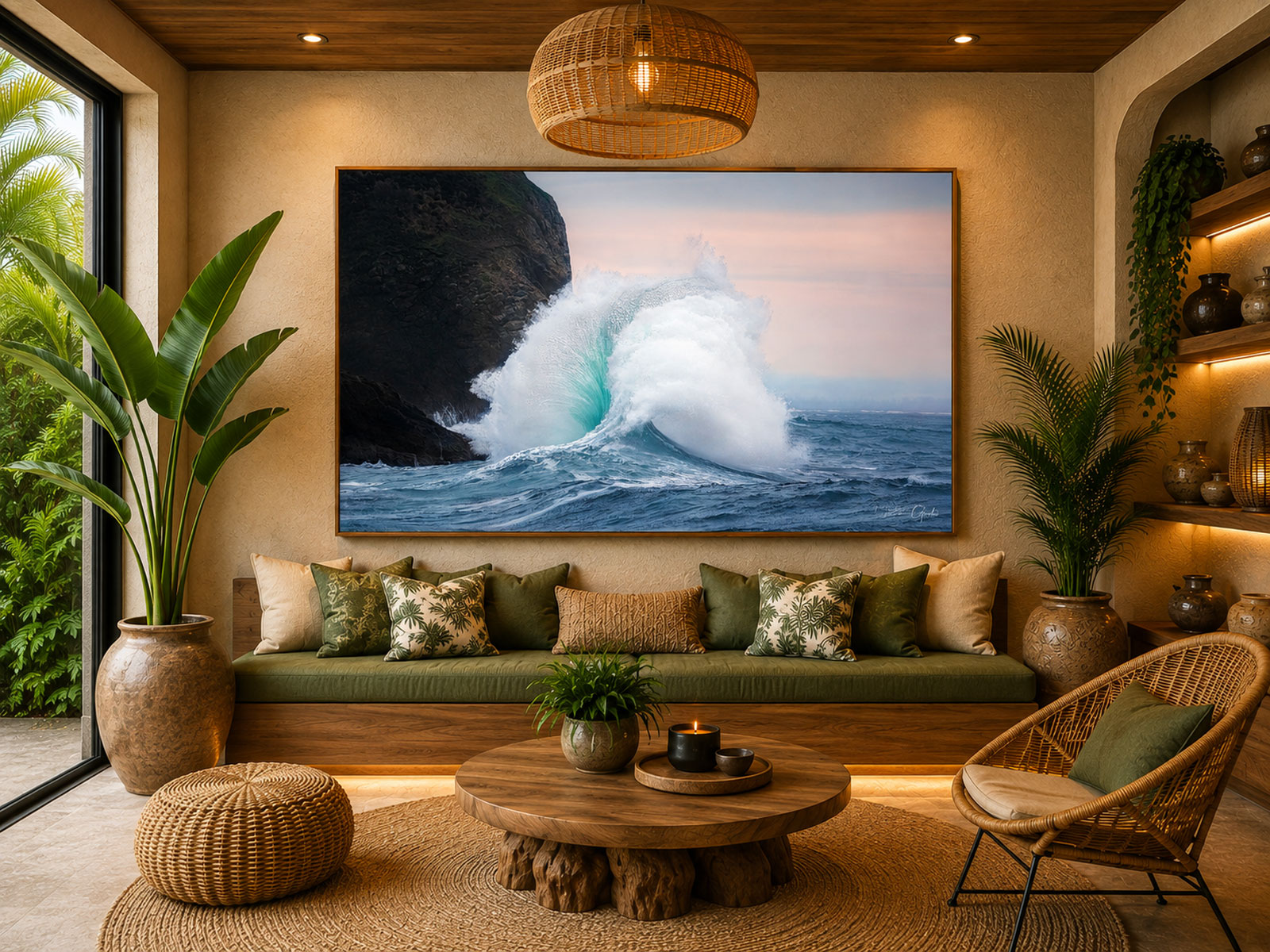
Turquoise Thunder, photographed on the Washington coast. In a room built entirely from earth tones, a single high-contrast piece becomes the only place the eye wants to rest.
What Defines a Tropical Modern Interior
Bali-inspired design has moved well past the carved-teak-and-batik cliché. What designers now call tropical modernism is a fairly precise set of choices: open-air layouts that blur the line between inside and out, high vaulted ceilings, natural materials left matte rather than polished, and a warm neutral base that lets the greenery outside do the talking.
The luxury end of this style has deliberately turned away from the stark white minimalism of a decade ago and toward something warmer and more textured. Raw stone. Unfinished wood. Linen instead of silk. Rooms that feel lived in rather than staged. It sits alongside biophilic design, the broader movement toward interiors that keep people connected to the natural world, which has become one of the strongest forces in residential and hospitality design.
All of which creates a specific problem when it comes to art. A room with no hard edges, no strong color, and no visual hierarchy needs something to organize it. Without that, the eye wanders and the room reads as pleasant but forgettable.
Quiet Rooms Need Loud Art
This is the mistake I see most often, and it is an understandable one. A homeowner builds a soft, sand-colored room and then chooses soft, sand-colored art to match it. The logic seems sound. The result is a space with no center, the visual equivalent of a hotel lobby.
A tropical modern room can absorb far more drama than people expect, precisely because everything else in it is so restrained. One piece with real contrast and real energy will not fight the room. It will give the room a reason to exist.
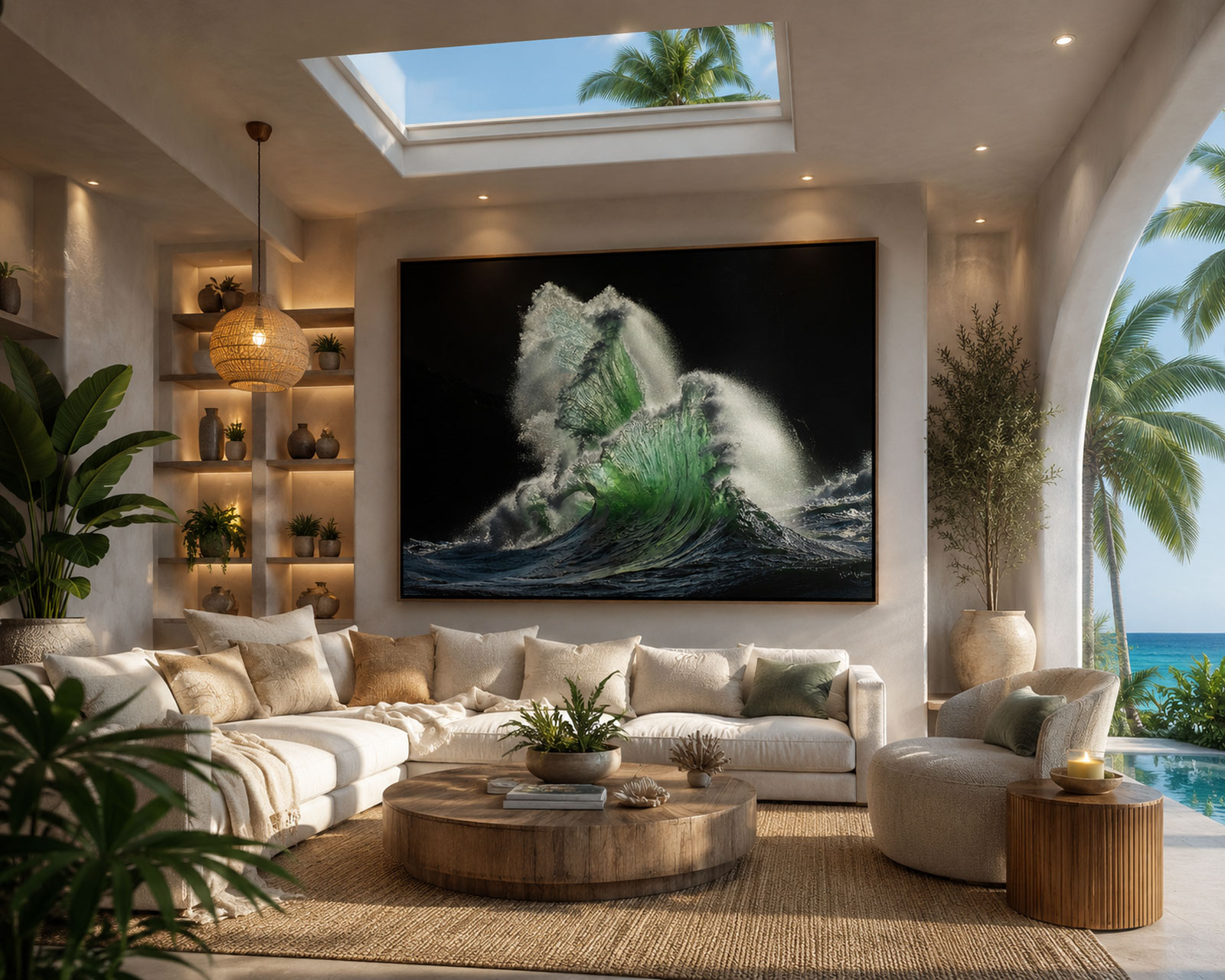
Neptune's Crown, photographed on the Pacific Northwest coast. A dark-field image in a pale, skylit room. Rather than closing the space down, the black ground reads as depth and pushes the wall back.
Dark artwork in a light room is the move most people are too cautious to make. It works for the same reason a window at night works. The eye reads black as distance, not as weight. In a room with a skylight and a wall of glass, a dark image gives all that light something to land against.
Deep Green Works as a Neutral
The counter-argument matters too, because not every room wants a focal point. Bedrooms and reading rooms are meant for rest, and a piece that demands attention every time you walk past it will wear thin.
Botanical work solves this. A close study of foliage behaves less like a picture and more like texture. It holds a wall, fills a space with color, and asks nothing of you. In tropical interiors, deep green functions almost exactly the way a warm grey does in a city apartment.
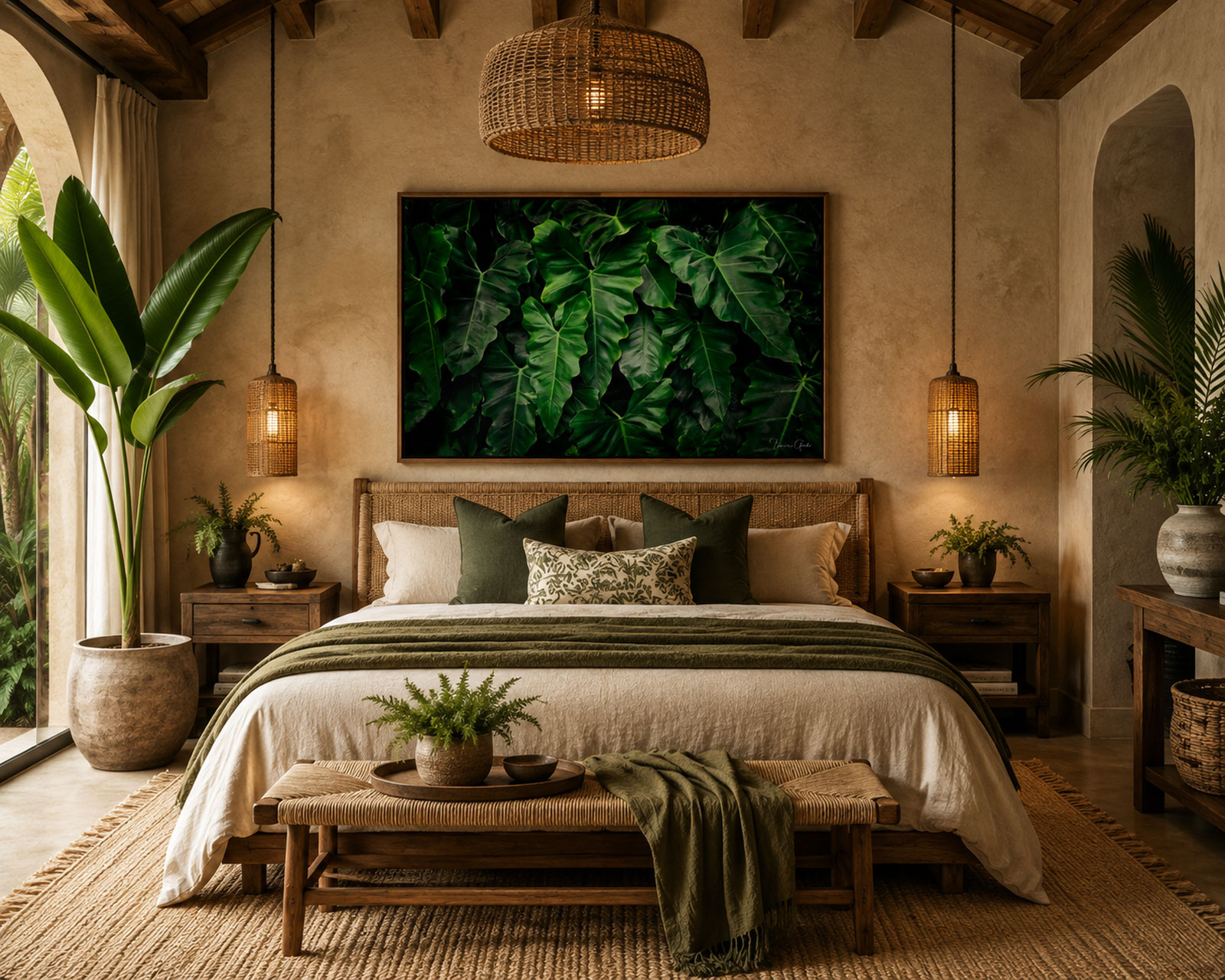
Hawaiian Tropical Leaves, above a woven headboard. The piece is roughly the width of the bed, which is the proportion that reads as intentional rather than accidental.
Above a bed, aim for artwork that spans somewhere between two-thirds and the full width of the headboard, hung eight to twelve inches above it. Anything narrower starts to look like a placeholder for the piece you meant to buy.
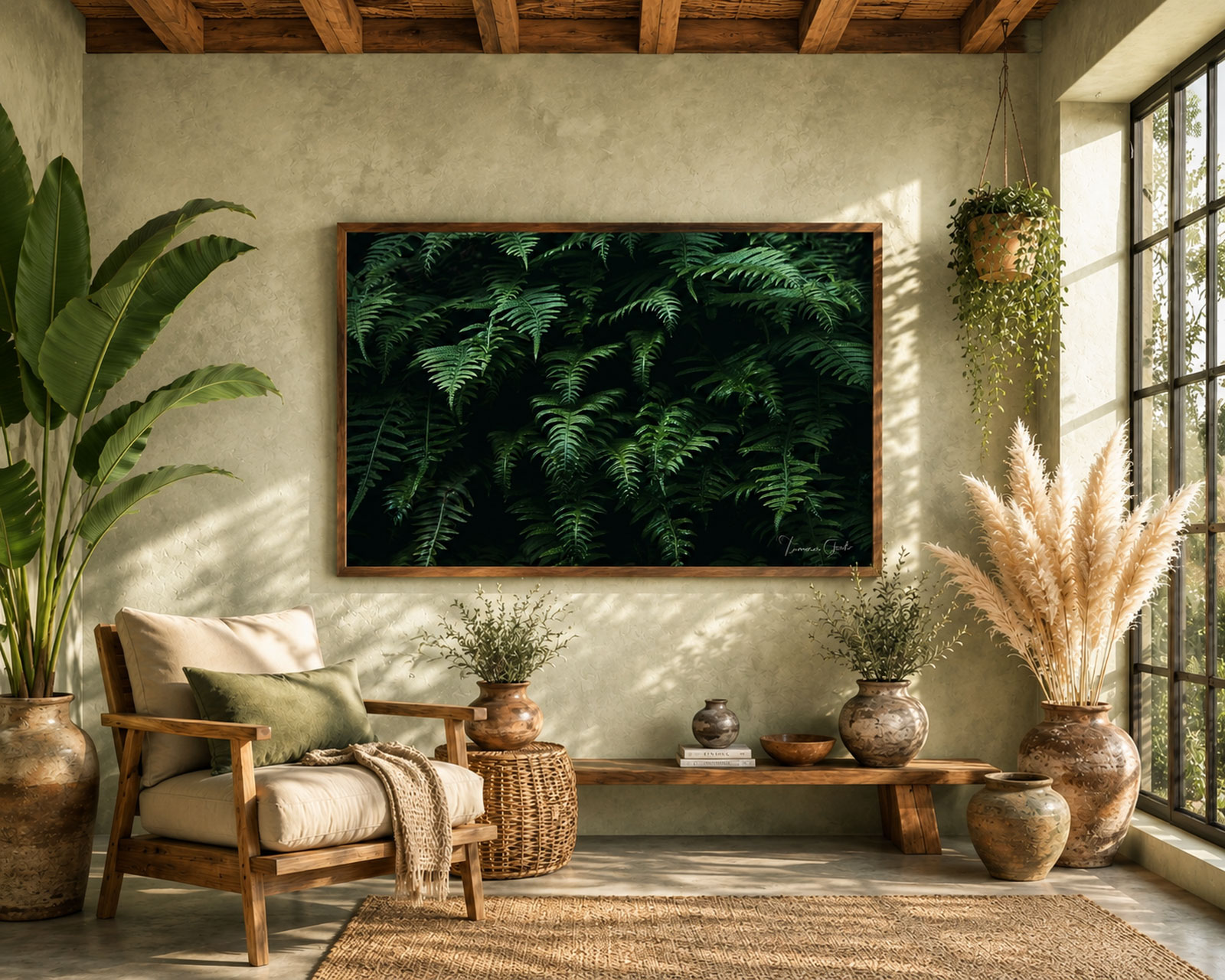
Forest Floor, sword ferns in the Columbia River Gorge. In a room flooded with hard afternoon light, a deep-toned image gives the space a still point and keeps the sun from flattening everything.
Look Beyond the Palm Leaf
Search for tropical wall art and you will be shown ten thousand versions of the same four subjects. Palm fronds. Monstera leaves. A sunset over water. A flamingo, for reasons no one has ever satisfactorily explained.
There is nothing wrong with any of them, but a room furnished entirely from the obvious column ends up feeling like a rental. What changes a space is a living subject, something with breath and motion in it.
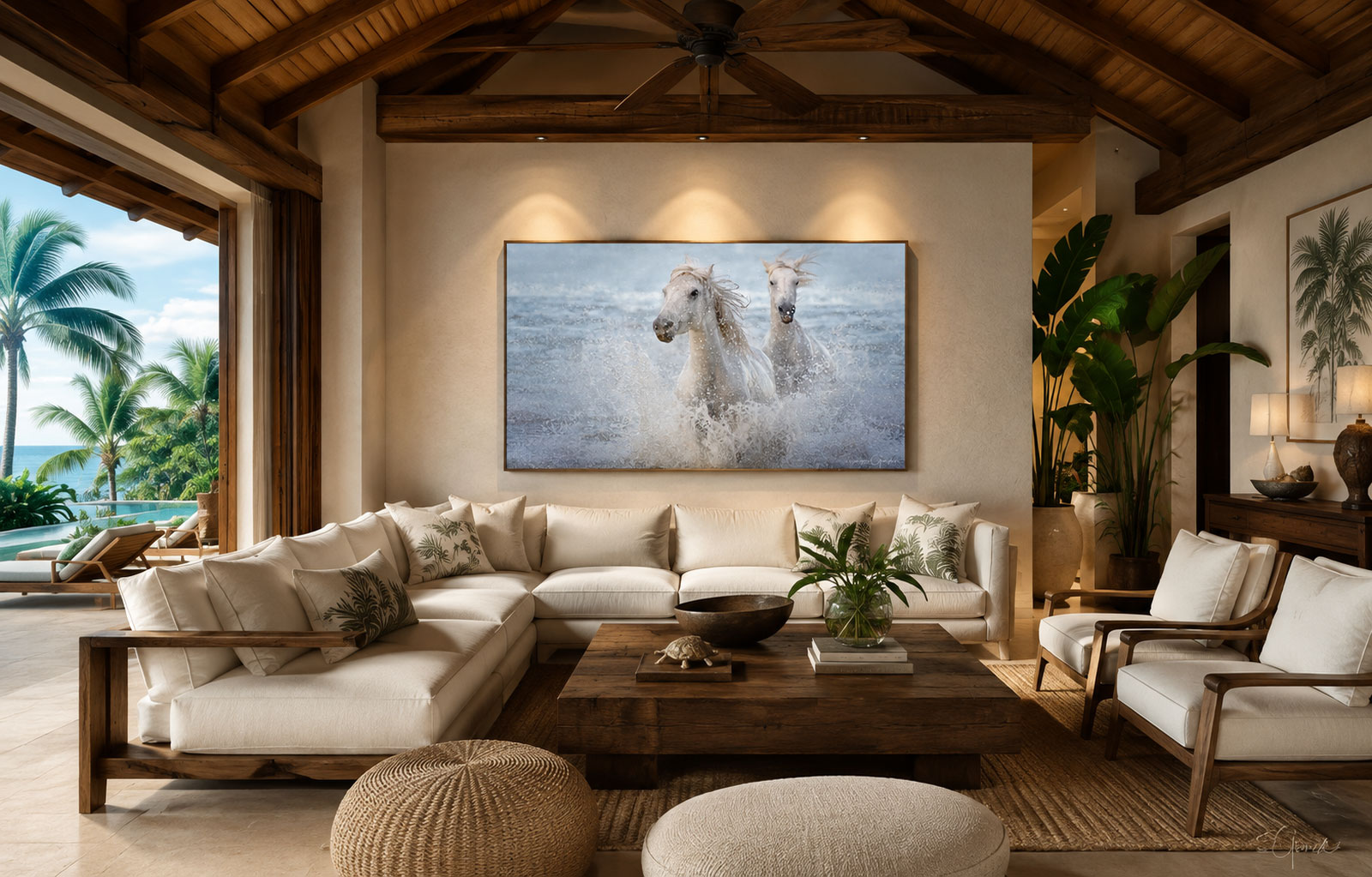
Born of the Sea. Two white Camargue horses running through breaking surf, in a room of teak, linen and open ocean.
Notice what this piece is not. It is not a picture of the tropics. It shares the room's palette, its silver-blue water and its sense of open air, and that turns out to be all the belonging it needs.
Tone, Light and Scale Matter More Than Subject
Here is something worth knowing about the seven rooms on this page. Five of these photographs were made in the Pacific Northwest, in cold water, under grey skies. One was made in the Camargue. Only one, the tropical leaves above the bed, was photographed anywhere near a tropical climate.
Not one of the seascapes is a tropical image. Every one of them belongs in the room it is hanging in.
This is the single most useful thing I can tell you about choosing art for a Bali-inspired home. Belonging is a question of tone, light and scale, not of subject matter or geography. A wave photographed off the Oregon coast in February carries the same turquoise and the same white water as one photographed off Maui. A fern in a Cascade rainforest is the same deep green as a fern in Ubud.
Once you stop shopping by category and start shopping by palette, the field of what can hang in your room opens up enormously. It also gets you out of the aisle where everyone else is buying.
How to Size Art for High Ceilings and Open-Plan Rooms
Most advice about hanging artwork assumes an eight-foot ceiling and a wall you stand three feet away from. Tropical modern architecture breaks both assumptions. Ceilings vault to twelve or fourteen feet. Furniture sits low and long. Sightlines run the length of an open plan and out through a sliding wall to the water.
A few things that hold true in these rooms:
- Over a sofa or sectional, size the piece to roughly two-thirds the width of the furniture below it. Over a sectional, measure the wall-facing run, not the whole L.
- Hang to the room's primary sightline, not to the ceiling. If the room is mostly experienced seated, center the piece around fifty-seven to sixty inches from the floor even under a fourteen-foot ceiling.
- Leave six to ten inches between the top of the sofa back and the bottom of the frame. More than that and the piece begins to float away from the furniture.
- In an open plan, size for the distance the piece is actually seen from. A work viewed from thirty feet across a great room needs to be considerably larger than the same work in a study.
- One large piece beats a cluster of small ones. This has become the prevailing approach in contemporary interiors, and it is especially true in rooms where the architecture is already generous.
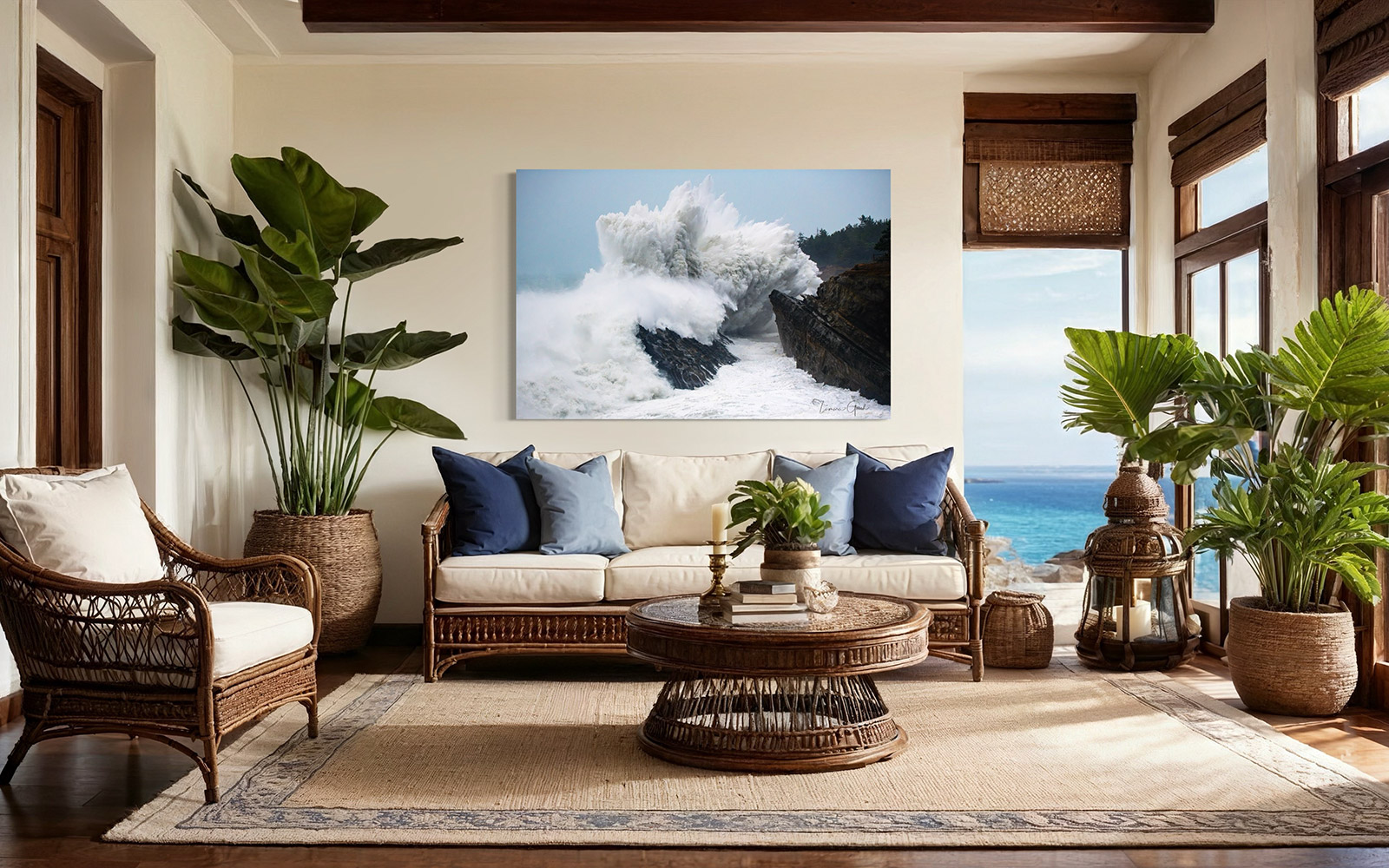
Explosive Power, photographed on the Pacific Northwest coast. Correct proportion against a smaller-scale seating group. The piece is wide enough to command the wall without overwhelming the sofa beneath it.
By far the most common error is going two sizes too small. It is an expensive mistake to discover after installation, which is why I offer a room visualization service, described in the Art Buying Guides. Send a photograph of your wall and I will show you the piece in your actual space, at the actual size, before anything is ordered.
Choosing a Print Medium for Humid, Sun-Filled Rooms
This is the question nobody writing about tropical interiors seems to answer, and it is the one that actually decides whether a piece lasts. Open-air rooms, bathrooms, poolside living spaces and homes near salt air are demanding environments for artwork. Paper and canvas were not designed for them.
The useful question is not which medium is better in general. It is whether the wall you have in mind has a moisture problem or a sunlight problem, because the answer is different for each.
If the room is humid, choose ChromaLuxe Metal. The image is infused directly into a coated aluminum panel. There is no paper surface, no glass, and nothing to warp or absorb moisture. Metal holds up better than acrylic in high humidity, including bathrooms with poor ventilation, and it is the standard recommendation for kitchens, wet rooms and coastal homes.
If the wall gets direct sunlight, choose Lumachrome HD TruLife Acrylic. Acrylic carries UV protection in both the ink and the acrylic itself, which makes it the better choice for a sunlit wall. TruLife is also anti-reflective, so in a room with a skylight, a wall of glass, or both, you keep looking at the photograph rather than at the reflection of your own furniture. It is abrasion resistant as well, which matters in a hallway or any high-traffic space.
If the wall is dry and out of direct sun, consider a DuraPlaq FloatPlaq. A mounted panel that sits slightly off the wall, giving depth without the visual weight of a frame. It suits rooms where the architecture is already doing a lot of work.

Garden Cascade, a Pacific Northwest waterfall, in a spa bath. A vertical image suits the proportions of a narrow room, and a water subject in a wet room is one of the few decorating decisions that never feels forced.
One practical note about placement. Even on a durable substrate, keep artwork out of the immediate splash zone of a shower or tub, and out of hours of unbroken direct sun where you have the choice. Position matters as much as substrate does.
Why Limited Edition Matters in a Room Like This
Return to where this started. The reason so many beautiful tropical interiors feel interchangeable is that nearly everything in them can be ordered by someone else tomorrow.
Every image in my collection is released in an edition of fifty worldwide, across all sizes and all media combined. When the edition closes, it closes. Compare that to a mass-market canvas print, which exists in tens of thousands of identical copies in tens of thousands of homes.
This is not only about scarcity as investment, though editions do behave differently from open-run reproductions. It is about the difference between decorating a room and building one. A limited edition piece is the element of the house that will not appear in your neighbor's.
For Interior Designers and Hospitality Buyers
I work directly with designers, architects and hospitality buyers, and the process is built to be straightforward.
- The Fine Art Trade Program offers an ongoing twenty percent trade discount, rising to thirty percent on orders of ten pieces or more.
- Room visualization is available at no cost for any piece under consideration, including multi-piece and full-property specifications.
- Licensing is available for hospitality, healthcare and large-format installation work where an edition print is not the right fit.
- Sizing, substrate and installation guidance is handled directly with me. There is no account manager between you and the artist.
My work has appeared in Cowboys & Indians, Ranch & Reata and Western Horseman, and hangs in private residences, ranches and commercial properties across the country.
The Pieces in This Guide
- Turquoise Thunder — a turquoise wave against a sea cliff, Washington coast
- Neptune's Crown — a green wave on a black ground, Pacific Northwest
- Explosive Power — surf exploding against a rocky coastline, Pacific Northwest
- Born of the Sea — two white Camargue horses running through breaking surf
- Garden Cascade — a moss-lined waterfall, Pacific Northwest
- Forest Floor — sword ferns, Columbia River Gorge
- Hawaiian Tropical Leaves — deep green tropical foliage, Hawaii
Where to Start
If you are furnishing a tropical modern home and are not sure where to begin, start with the room everyone gathers in and choose one piece for it that is larger and bolder than feels comfortable. Get that decision right and the rest of the house follows easily.
Browse the Pacific Northwest collection for seascapes, waterfalls and forest work, or the botanical collection for foliage studies. If you would rather start with your wall than with the art, get in touch with your dimensions and a photograph of the space. I will tell you honestly what will work in it and what will not.
More guidance is available in the Art Buying Guides.
Frequently Asked Questions
What kind of art works best in a Bali-inspired home?
Tropical modern interiors use a deliberately quiet palette of warm off-whites, terracotta, muted sage and teak, which means the artwork has to supply the room's contrast and energy. High-contrast seascapes, water studies and large-scale botanical work all suit these rooms. Match the tone, light and scale of the space rather than looking only for tropical subject matter.
Should artwork in a tropical interior be light or dark?
Both work, but for different jobs. A dark, high-contrast piece gives a pale room a focal point and reads as depth rather than weight, which is why it does not close down a light-filled space. Deep green botanical work behaves more like texture and suits bedrooms and reading rooms where you want calm rather than a focal point.
How large should artwork be above a sofa or sectional?
Size the piece to roughly two-thirds the width of the furniture below it, and leave six to ten inches between the top of the sofa back and the bottom of the frame. Over a sectional, measure the run of furniture against the wall rather than the full L shape. The most common mistake is choosing a piece two sizes too small.
How high should art be hung under a vaulted ceiling?
Hang to the room's sightline, not to the ceiling. Even under a twelve or fourteen foot ceiling, center the piece around fifty-seven to sixty inches from the floor if the room is mostly experienced from a seated position. Chasing the ceiling height pushes artwork above the natural line of sight.
What size art should go above a bed?
Choose a piece spanning between two-thirds and the full width of the headboard, hung eight to twelve inches above it. In a bedroom, a single large horizontal piece almost always reads better than a group of smaller works.
Can you hang fine art photography in a bathroom?
Yes, provided the substrate suits the room. ChromaLuxe metal is the best choice for a bathroom because the image is infused into a coated aluminum panel with no paper surface and nothing to warp, and it holds up better than acrylic in high humidity, including bathrooms with poor ventilation. Keep the piece out of the immediate splash zone of a shower or tub.
Should I choose acrylic or metal for a tropical or coastal home?
It depends on whether the wall has a moisture problem or a sunlight problem. Choose ChromaLuxe metal for humid rooms such as bathrooms, kitchens and wet or coastal spaces, since it resists moisture better than acrylic. Choose Lumachrome HD TruLife acrylic for sunlit walls, because acrylic carries UV protection in both the ink and the panel, and its anti-reflective surface controls glare from skylights and glass walls.
Does artwork need to show tropical subjects to suit a tropical room?
No. Belonging in a room is determined by tone, light and scale far more than by subject. A seascape or a water study with the right palette will sit comfortably in a tropical modern interior even though it was not photographed in the tropics.
What does a limited edition of 50 mean?
It means only fifty prints of that image will ever be released worldwide, counted across all sizes and all media combined. Once the edition closes, no further prints are produced. This is different from open-edition canvas reproductions, which are printed in unlimited quantities.
Do you work with interior designers?
Yes. The Fine Art Trade Program offers an ongoing twenty percent discount, rising to thirty percent on orders of ten pieces or more. Room visualization is included at no cost for any piece under consideration, and licensing is available for hospitality, healthcare and large-format installations.
Can I see how a piece will look on my wall before ordering?
Yes. Send a photograph of the wall along with its dimensions and I will produce a visualization showing the piece in your actual space at the actual size. There is no charge for this, and it is the most reliable way to avoid ordering a piece that is too small.
Have a question that is not answered here? Send me a note with your wall dimensions and a photograph of the room, and I will answer it directly.