Choosing fine art photography comes down to four decisions in this order: the subject you want to live with, the scale the wall needs, the print medium the room's light will allow, and the edition that makes the piece a documented object rather than a poster. Get those four right and the piece will still be right in twenty years.
I have spent my career photographing horses, wildlife, the American West, and the landscapes and coastlines in between — in pastures in Andalusia, on the Rhône delta, in the Serengeti, on the Oregon coast, and across the Desert Southwest. Over those years I have helped several thousand collectors, designers, and hospitality buyers choose work for a specific wall in a specific room.
The mistakes are remarkably consistent. People buy too small. They buy the image that impresses fastest instead of the one that lasts. They choose a print medium without looking at where the light comes from. And they choose a subject to match a room rather than to change it.
This page is the short course. Each section answers one question directly, then links to the full guide on that topic.
Find your answer
Before you begin
Right for your space
Getting the size right
Seeing it on your wall first
Choosing the medium
Hanging and lighting
Buying with confidence
Editions and authenticity
Buying direct
Value over time
Price and lead time
Designers and trade
In a hurry? Skip to the order of operations.
What should I look for in a fine art photograph?
Look for a photograph that still holds your attention on the third viewing. Technical quality is the floor, not the reason to buy. The image should reveal something in year three that you did not notice in week one.
Four things separate a collectible photograph from a decorative one:
- Light that could not be staged. Fine art nature and equine photography is made in conditions the photographer waited for — not conditions they arranged. That waiting is most of the work, and it is what you are paying for.
- Restraint. Images that shout are exciting for a month and invisible after that. Tonal, quieter work grows on a room.
- Dignity in the subject. An animal photographed with respect rather than drama ages far better on a wall. This applies to horses, to predators, and to people.
- A defined edition. If the same image can be reproduced without limit, it is a product. If the edition is closed, signed, and numbered, it is a work.
Every photograph I release is a limited edition of 50 worldwide, counted across all sizes and mediums combined. When an edition closes it does not reopen. More on how editions work.
Further reading: The Collector's Guide and The Craftsmanship of Large Format Prints.
How do I choose the subject?
Choose for what you want the room to feel like, not for what the room already contains. Landscape and seascape open a space up. Equine work brings warmth and living presence. Western imagery brings narrative. Wildlife makes the strongest single focal statement.
My archive is organized into four bodies of work, and collectors regularly arrive certain they want one and leave with another. Do not narrow too early.

| Collection | What it does to a room | Works best in |
|---|---|---|
| Equine Andalusian, Friesian, Camargue, Lusitano, Marwari, Gypsy Vanner, wild mustang | Warmth, movement, a living presence. Reads as personal in a way landscape does not, and carries extraordinarily well at large scale. | Entries, great rooms, stairwells, ranch and equestrian properties, primary bedrooms |
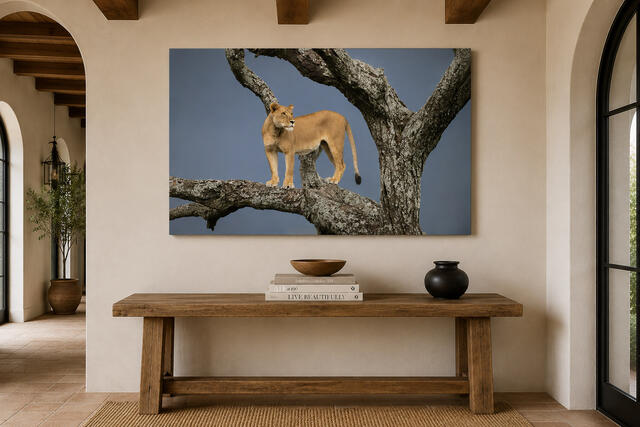
| Wildlife Big cats, elephants and predators from Tanzania and the Serengeti; North American wildlife from Yellowstone, Grand Teton, and Glacier | The strongest single focal statement available. One wildlife image can anchor an entire room on its own. | Studies, libraries, boardrooms, lodge and hospitality public spaces |
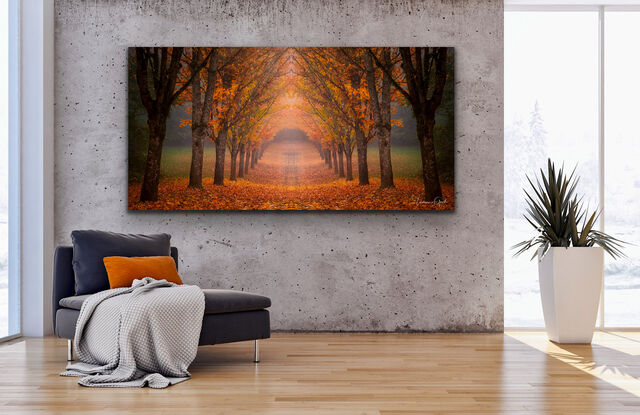
| Landscape & Seascape The American West, the Pacific Northwest coast, the Desert Southwest, Iceland | Functions as a window. Opens the room up, gives the eye somewhere to travel, holds a space calm. | Living rooms, dining rooms, offices, guest rooms, any interior space with no view of its own |
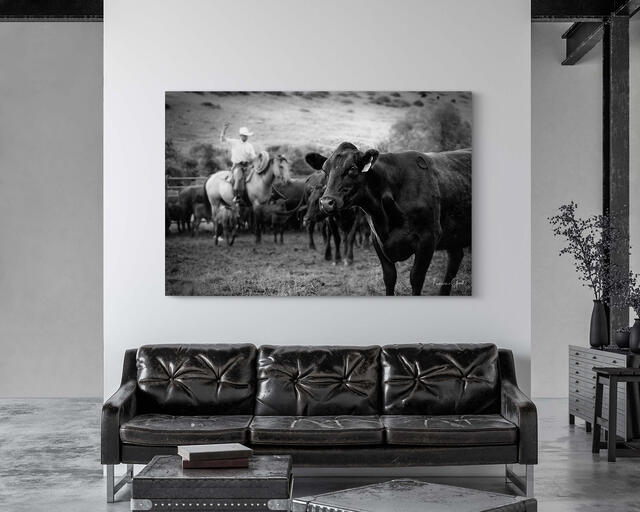
| Western & Cowboy Working ranch life, horsemanship, rodeo, portraiture across the American West | Narrative and character. These images invite the question who is that, and where is this. | Bars, dens, restaurants, western and lodge interiors, rooms built for conversation |
On matching a color palette: harmonize, do not match. Art chosen to match a throw pillow is wrong the moment the pillow is replaced. Identify whether your room runs warm or cool, choose an image that shares that temperature, and let one color in the photograph pick up something already in the space — the leather of a chair, the grey of a stone hearth, the blue of a rug. Neutral rooms carry saturated, high-contrast work. Rooms already busy with pattern and color are better served by quieter, tonal work. When in doubt, tonal wins.
Deeper dives: wild horse fine art for collectors and designers, anchoring a room with desert photography, and bringing the sea into your home with ocean photography, and art for a Bali-inspired home.
What size fine art print should I buy?
The print should span two-thirds to three-quarters of the width of the furniture beneath it, or 60 to 75 percent of a bare wall. Undersizing is the single most common regret in buying fine art photography.
- 72-inch sofa → 48 to 54 inches wide
- 84-inch sofa → 56 to 63 inches wide
- 96-inch sofa → 64 to 72 inches wide
- Bare wall, no furniture → 60 to 75 percent of the wall width
Two things people forget. First, viewing distance supports scale — a piece seen from twelve feet across an open room can carry far more size than one seen from six feet in a hallway. Second, if you buy on paper, the mat and frame add substantially to the finished dimensions: a 30×40 inch print can finish at 40×50 inches once framed.
You do not have to guess. I will render your chosen image into a photograph of your own wall at true scale, at no charge, before you order anything. How room visualization works.
Full guide: choosing large photographs for your walls.
Can I see the print in my room before I buy?
Yes, and at no charge. Send me a straight-on photograph of your wall and I will render your chosen image into it at true scale before you commit to anything.
Photograph the wall square-on, in the light you normally use the room in, and include something of known size in the frame — a door frame, a sofa, a light switch. If you know the wall's width, tell me. That is all I need.
What comes back is your room with the piece in it, at the size you are considering. If you are torn between two sizes, I will show you both at true scale, so you are comparing them against your own furniture rather than against each other on a screen.
Most collectors change their size decision after seeing it, and nearly always upward. A piece that felt daring in the abstract usually turns out to be the right one on the wall — and undersizing is the mistake people regret, not overshooting.
On print medium, I will not fake it. How a surface behaves depends on where the light falls in your particular room, and a simulated reflection would only tell you what my software thinks, not what you would actually live with. Tell me instead where the windows and lamps are in that room and at what hour you use it, and I will tell you honestly which medium suits that wall — including when the answer is not the one that photographs best online.
There is no charge and no obligation. Request a room visualization. Designers and consultants receive this on every specified piece as part of the trade program.
Which print medium should I choose?
Light decides this, not style. Walk into the room at the hour you use it most and look at the wall. If you can see windows or lamps reflected there, that reflection will land on your photograph too.
| Medium | Character | Choose it when |
|---|---|---|
| Lumachrome® HD TruLife® Acrylic | Luminous and dimensional, as though lit from within. The deepest blacks and most saturated color of the four. The TruLife facing is anti-reflective, so it does not mirror the room the way ordinary acrylic does. | Maximum impact; bright rooms and walls opposite windows; large-format statement pieces |
| ChromaLuxe® Metal | Vivid, crisp, contemporary. The image is infused into the aluminum panel, so it is waterproof, scratch resistant, and can be wiped clean. | Modern interiors; kitchens, baths, spas, coastal properties; high-traffic hospitality space |
| DuraPlaq® FloatPlaq | Warm, tactile, dimensional. A matte surface that holds light instead of throwing it back — the lowest-glare option. | Rustic-modern, western, ranch and lodge interiors; softer or more painterly images |
| Archival fine art paper | Matte, restrained, the most classically photographic. Supplied unframed so you control mat, frame, and glazing. | Traditional and transitional rooms; gallery-wall groupings; collectors who want to specify their own framing |
Acrylic, metal, and FloatPlaq arrive fully finished and ready to hang, hardware included. Paper ships unframed; custom framing is available through the studio by request. If you want to know how one specific image renders on two different mediums, ask me — that answer is image-specific and I am glad to give it.
Full detail on surfaces, framing, and care: Selecting Prints and Prints and Framing.
How high should fine art photography hang, and how should it be lit?
Hang the piece so its center sits 57 to 60 inches from the floor. Light it from about 30 degrees off the wall with high-CRI LED. Anchor into studs for anything over 40 inches.
- Above a sofa: leave 8 to 10 inches between the sofa back and the bottom edge of the piece.
- Above a mantel: leave 4 to 12 inches above the shelf. A frameless mounted piece handles fireplace heat and soot better than paper under glass.
- Lighting: LED at CRI 95 or higher. Color rendering matters far more than color temperature. Install a dimmer — light level changes how acrylic reads more than anything else you can control.
- Never direct sun, on any medium, regardless of UV rating.
Full guides: lighting fine art photography and the art installation resources directory.
What is a limited edition, and why does it matter?
A limited edition is a permanent cap on how many prints of an image will ever exist. Mine is 50 worldwide, counted across every size and every medium combined. When an edition closes, it does not reopen.
That counting method matters more than the number. A 24-inch paper print and a 72-inch acrylic each take one number out of the same 50. Many photographers run separate editions per size or per medium, which means an edition of 50 can quietly mean several hundred prints in circulation. Mine cannot.
Every print is signed and numbered by hand and arrives with a certificate of authenticity recording the title, edition number, size, medium, date of production, and my signature. Keep it with your insurance documents — it is what establishes provenance if the piece is ever appraised, insured, resold, or passed on.
An open edition has none of this. No fixed supply, no number, no certificate, and no record that any particular print is anything other than one more copy of a file. More on collecting and provenance in The Collector's Guide.
Should I buy direct from the photographer or from a print marketplace?
Buy direct if you want a closed edition, a signed certificate of authenticity, control over the print medium, and the photographer's own eye on the sizing decision. Marketplaces sell open editions of the same file to anyone who wants one.
An open-edition print from a marketplace is a reproduction. It has no edition number, no fixed supply, no provenance, and no one at the other end who knows the image. Buying direct means the print is made to order at a fine art lab, signed and numbered, documented with a certificate, and packed and insured for the size it actually is. It also means you can call me before you commit.
Comparison in full: Fine Art America vs buying direct from the artist.
Is fine art photography a good investment?
Buy a photograph because you want to live with it. Some photography holds value and some appreciates, but nobody should buy a print primarily as a financial instrument, and I am not going to tell you otherwise.
What genuinely supports the value of a photographic work: a closed and honestly counted edition, documented provenance, archival materials with a real lifespan, and an artist with a continuing body of work and a public record. My photography has appeared in Cowboys & Indians, Ranch & Reata, and Western Horseman, and the materials I print on are rated beyond a hundred years under normal display conditions.
What does not support value: open editions, undocumented prints, and marketplace reproductions, no matter how good the image is.
The honest picture is that the secondary market for living photographers is thin. Most work is bought to be lived with rather than traded, and you should assume that is what you are doing. The return is that you look at something you love every day for decades, and that it is still worth looking at when it passes to someone else.
If you own several pieces, have them scheduled on your homeowner's policy and keep the certificates. That is the practical part of collecting that most people skip.
What does a fine art photography print cost, and how long does it take?
Prints run from around $399 for smaller works to $10,000 for major large-format installations. Every piece is made to order, and production is currently running about four to six weeks.
The price includes the finished artwork in your chosen size and medium, the hand-signed certificate of authenticity, my signature, archival packaging, and hanging hardware on acrylic, metal, and FloatPlaq pieces. Framing on paper prints, shipping on large-format work, professional installation, and sales tax are separate. Payment plans are available on larger acquisitions — arrange one before ordering.
Everything about ordering, packing, delivery, inspection, and care is on the Selecting Prints page, and the common questions are answered on the FAQ.
I am an interior designer or art consultant. Is there a trade program?
Yes. The Fine Art Trade Program offers 20 percent off for approved trade accounts and 30 percent on orders of ten pieces or more, plus collection lookbooks, room visualization on every specified piece, and direct support on sizing, medium selection, and installation sequencing.
Designers specifying residential projects, hospitality groups sourcing guest rooms and public spaces, and consultants building corporate collections all work with me the same way: bring me in before the image is chosen, not after. A designer thinking about the whole room will catch scale and sightline problems that are almost impossible to see from inside your own house.
Fine Art Trade Program · Trade portfolio · Does art matter in the workplace?
A simple order of operations
- Measure the wall, the furniture beneath it, and your usual viewing distance.
- Note where the light comes from, at the hour you actually use the room.
- Choose the medium that suits that light.
- Choose the image you want to live with — not the one that impresses fastest.
- See it rendered to scale in your own room before you commit.
- Order, then hang it at 57 to 60 inches on center and light it properly.
Choosing art is not really a design problem. It is a question of what you want to be looking at while your life happens in front of it. Get the scale and the medium right, then trust the image that keeps pulling you back.
Browse the collections · Request a free room visualization · All art buying guides
Every guide in this library
How to Choose Fine Art Photography for Your Home
Start here if you have never bought original art before.
Editions, provenance, certificates, and collecting as legacy.
Choosing Large Photographs for Your Walls
Scale and proportion, and why undersizing is the most common regret.
The complete ordering, medium, care, and delivery reference.
Every print medium and framing option, side by side.
The Craftsmanship of Large Format Prints
How the work is actually made, from capture to finished panel.
Lighting fine art photography: colour rendering, angle, and dimming.
Professional installers for large-format and multi-piece work.
Room-specific guidance for the space you use most.
Choosing art for tropical modern and Bali-inspired interiors.
Guide to Equine and Landscape Photography
The two bodies of work, and how each behaves on a wall.
Mustang and wild horse work for collectors and designers.
Anchoring a Room with Desert Photography
Desert and Southwest imagery at large format.
Ocean and Seascape Photography at Home
Bringing the coast indoors, and where it works best.
Marketplace or Direct from the Artist?
What you give up buying an open edition from a print marketplace.
Does Art Matter in the Workplace?
Art in offices, corporate collections, and commercial interiors.
20% for approved trade accounts, 30% on ten pieces or more.
Curated work for designers, hospitality, and corporate specification.
Quick answers on ordering, shipping, packing, and care.